West Dallas Auto Clinic | Intelligent Solutions | Expert Auto Diagnostics Dallas TX
West Dallas Auto Clinic Intelligent Solutions
Dallas, TX · Automotive Electronics Specialists

We Find
What Others Miss

Precision electronic diagnostics, ECU programming, and full-system scanning. We don't guess, we diagnose.

Most Makes and Models
1 to 2 Day Diagnostics
OEM Diagnostic Tools
Mon through Sat
15+
Years Experience
10K+
Vehicles Diagnosed
98%
Accurate First Time
50+
Error Codes Decoded
Know Before You Go

Our Diagnostic Policy: Explained Simply

We believe in complete transparency before we touch your vehicle. Here is exactly how our diagnostic process and pricing works.

🔧
Level 1 Diagnostic

Our certified technicians perform a complete system scan and review of faults. Includes road testing, monitoring live data to replicate the issue, researching manufacturer technical service bulletins (TSBs), and verifying current software versions.

📋
What Happens Next

After the Level 1 diagnostic we either provide a repair estimate or determine that a Level 2 diagnostic is required for more complex issues. Diagnostic fees are not applied toward the repair cost. They cover the expertise, tools, and ongoing certification our technicians invest in to find the root cause accurately.

Our Process

The CLINIC Method

Every vehicle goes through our 6-step CLINIC method. A repeatable process that finds the actual cause instead of guessing at it.

C

Collect Evidence

  • Document when the issue started
  • Customer interview (what, when, why, how)
  • Review history and past repairs
  • Pull fault codes from all modules
  • Full function test and road test
  • Visual inspection throughout
  • Review known technical bulletins
L

Localize the Fault

  • Determine if it is a real fault
  • Identify what is relevant vs. not
  • Find where to begin diagnosis
  • Understand what could have caused it
  • Plan for intermittent issues
  • Review wiring diagrams in detail
I

Investigate Findings

  • Plan the test sequence
  • Select the right diagnostic tools
  • Choose static or dynamic test method
  • Define what good vs. bad results look like
  • Follow the plan precisely
  • Record all results
N

Narrow the Cause

  • Don't replace parts yet
  • Review all gathered evidence
  • Identify the root cause
  • Apply the 5 Whys method
  • Prevent repeat failures
I

Implement Repair

  • Follow manufacturer procedures
  • Use the correct repair process
  • Use required special tools
  • Perform calibration routines
  • Reference repair bulletins
  • Avoid causing a second fault
C

Confirm the Fix

  • Replicate original conditions from Step 1
  • Perform same tests from Step 3
  • Verify repair from Step 4
  • Consider OBD Drive Cycle
  • Ensure the problem does not return
Monday through Friday
7:00 AM to 6:00 PM
Saturday
7:00 AM to 2:00 PM
Sunday
Closed
What We Actually Scan

We test,
we don't guess.

Our diagnostic doesn't stop at the engine. We pull data from every module, every system, every bus, so a hidden fault in one corner of your car can't hide from the rest of it.
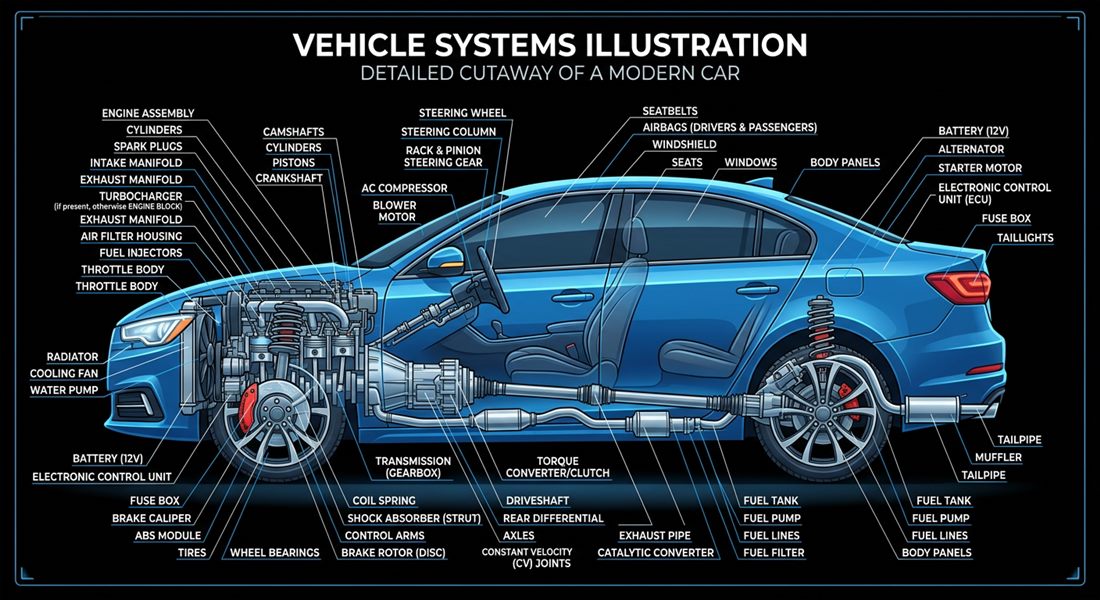
Cutaway illustration of a vehicle showing engine, drivetrain, brakes and electrical systems being scanned
Engine
OK
Powertrain
OK
Drivetrain
Check
Fuel
Check
Cooling
OK
HVAC
OK
Electrical
OK
Brake
OK
Exhaust & Emissions
OK
Steering
OK
Our Services
🏁 Engine Drivability & Performance Diagnosis ⚙️ Transmission Diagnostics Electrical & Electronic Faults

From a simple check engine light to complex module programming, our team handles all automotive electronics.

🔴

Check Engine Light

Complete OBD-II scan and root-cause diagnosis. We read every module, not just the engine, and we fix it right the first time.

🧠

ECU Diagnostics

Engine Control Unit testing, reprogramming, and fault analysis. If the brain is bad, the car will lie to you, we find out why.

💻

Module Programming

Factory-level programming and flashing for PCMs, TCMs, BCMs, and more. We use OEM tools for accurate, safe updates.

🔁

ECU Cloning

Transfer your original ECU data to a replacement unit, keeping your VIN, calibrations, and immobilizer settings intact.

⚙️

Transmission Diagnosis

Scan and analyze TCM faults, solenoid issues, shift adaptations, and more before recommending any costly repairs.

🔗

Network and Bus Faults

CAN Bus, LIN, and network communication failures diagnosed with advanced oscilloscopes and live data analysis.

🛑

ABS and Brake System

ABS module scanning, wheel speed sensor diagnosis, and brake system electronic fault identification.

📞

Not Listed? Call Us

Don't see your specific issue? Contact us directly. Chances are we have seen it before and can help.

Common Questions

You Ask, We Answer

How long does a diagnostic take?

+

Diagnostics typically take 1 to 2 days depending on the complexity of the issue. Complex electrical or intermittent problems may require more time, but we will always give you a realistic timeframe upfront before we begin.

Is the diagnostic fee applied toward my repair?

+

No. Diagnostic fees are separate from repairs and are not credited toward the repair cost. They cover the expertise, tools, and ongoing certification required to accurately identify the root cause of the issue.

My check engine light is on but the car seems fine. Do I need to come in?

+

Yes, and soon. A check engine light always means something is wrong, even if the car feels normal. Ignoring it can lead to failed emissions, worse damage, and much larger repair bills. Some faults also become intermittent, making them harder and more expensive to diagnose later.

Do you work on all car brands?

+

We work on most makes and models, domestic, import, and European. Call us with your specific vehicle to confirm before bringing it in.

Can I just get my codes read for free somewhere else?

+

Auto parts stores will read codes for free, but reading a code is only the beginning. A code tells you what system failed, not why it failed. Without a full diagnosis, you risk replacing the wrong parts. Our diagnostics identify the root cause so the repair actually fixes the problem.

Before You Come In

Before You Call

A few quick answers to the questions we hear most, so you know what to expect before you reach out.

Is there a fee just to get looked at?

+

Yes. There is a fee for diagnostic work. Our Level 1 diagnostic includes a complete system scan, road testing, live data monitoring, and research into manufacturer technical service bulletins. If a more complex issue is suspected, a Level 2 diagnostic may be required. Diagnostic fees are not applied toward the repair cost. They cover the expertise and tools required to find the root cause accurately. Call 214-964-0986 for current pricing.

Do I need an appointment or can I walk in?

+

Appointments are preferred to ensure we can dedicate proper time to your vehicle. Walk-ins are welcome when space is available, but we cannot guarantee same-day service without a scheduled slot.

What should I bring when I drop off my car?

+

Bring your keys (all of them if you have more than one), any relevant service records, and be ready to describe the problem in as much detail as possible, when it happens, how often, and under what conditions.

Electronic Failures Explained

Understand Your Diagnostic Issue

Plain English explanations of common automotive electronic failures, what they mean, what causes them, and how we diagnose them.

Check Engine Light

What That Orange Light Really Means

The Check Engine Light (CEL), officially the Malfunction Indicator Lamp (MIL), turns on when your car's onboard diagnostic system detects something outside of normal operating parameters. It can represent hundreds of different fault codes across multiple vehicle systems.

Most people assume it means "engine trouble." In reality, the CEL can be triggered by a faulty sensor, a loose gas cap, a misfiring cylinder, a failing catalytic converter, or a complex electronic fault. The only way to know for certain is a proper diagnostic, not just a code read.

Why it matters: Ignoring the CEL can cause secondary damage, failed emissions tests, reduced fuel economy, and safety risks. Some codes are urgent. Some are not. A trained technician can tell you which is which.

Common Causes We Diagnose

Oxygen Sensor Failure

Bad O2 sensors cause poor fuel economy and can damage your catalytic converter if left too long.

Catalytic Converter Issues

A failing cat triggers P0420/P0430 codes. Proper diagnosis determines if the cat itself, or another part, is the actual cause.

Engine Misfires

Misfires cause rough idle, loss of power, and fuel waste. Could be ignition coils, injectors, or compression issues.

EVAP System Leaks

Vapor leaks from the fuel system are common, from something as simple as a loose gas cap to a cracked hose.

Mass Airflow Sensor

A dirty or failed MAF sensor causes rich/lean conditions, poor throttle response, and stalling.

🔍 How We Diagnose It

1
Full Module Scan

We scan every module, not just the engine, because other systems can trigger the CEL.

2
Live Data Analysis

We monitor real-time sensor data to catch issues that codes alone won't reveal.

3
Root Cause Testing

We test components to confirm the actual failure, not just chase codes.

4
Written Report

You get a clear explanation of what's wrong and what's needed before any work begins.

Typical Time

1 to 2 days for standard CEL diagnosis. Complex or intermittent issues may take longer.

Ready to Find Out?

Don't wait for a small problem to become a big one. Contact us to schedule your diagnostic today.

Book a Diagnostic
ECU Failure

When Your Car's Brain Fails

The ECU (Engine Control Unit), also called the PCM, is the computer that manages your engine's fuel injection, ignition timing, emissions controls, idle speed, and more. When it fails, it can cause a wide range of symptoms that are often misdiagnosed as mechanical problems.

ECU failures can be caused by water damage, voltage spikes, heat damage, physical damage, corrupted software, or failed internal components. The tricky part is that a bad ECU can make perfectly good sensors throw false fault codes, leading shops to replace the wrong parts.

Symptoms of ECU Failure

Won't Start or Hard to Start

The ECU controls fuel and spark, a failing unit can prevent starting or cause random no-start conditions.

Poor Performance and Misfires

Erratic fuel delivery or ignition timing from a bad ECU causes stumbling, hesitation, and power loss.

Multiple Random Fault Codes

When an ECU is failing internally, it often throws codes across many unrelated sensors and systems simultaneously.

Failed Emissions Test

A corrupted ECU can cause your vehicle to fail state inspection even when all other components are working correctly.

🧠 ECU Testing Process

1
Power and Ground Test

Verify the ECU receives proper voltage and clean grounds before assuming internal failure.

2
Communication Test

Confirm the ECU can communicate on the vehicle's data network.

3
Output Testing

Command injectors, solenoids, and relays through the ECU to verify output circuits.

4
Software Verification

Compare installed software version to current OEM calibrations.

💡
Good News

Many "failed" ECUs can be reprogrammed or repaired rather than replaced, saving significant cost.

Module Programming

Flashing and Programming Explained

Modern vehicles contain dozens of electronic control modules, the ECU/PCM, TCM (transmission), BCM (body), ABS module, instrument cluster, and more. Each one runs software that must be current and properly calibrated to your specific vehicle's configuration.

Module programming (also called "flashing") is required when you install a replacement module, when a manufacturer releases an updated software calibration, or when a module loses its programming due to a battery issue or voltage spike.

OEM-Level Tools: We use factory-level programming equipment, not generic aftermarket tools, to ensure your module is programmed correctly and safely. Wrong programming can cause serious issues or permanently damage a module.

When Programming Is Required

New Module Installation

Any new or used replacement module must be programmed to match your vehicle's VIN and configuration.

Software Updates via TSB

Manufacturers release updated software to fix bugs, improve performance, or correct fault code issues.

Corrupt or Lost Programming

Power interruptions during a software update or a dead battery can corrupt module memory.

💻 Modules We Program

PCM / ECM
⚙️ TCM
🔒 BCM
🛑 ABS Module
🎛️ Instrument Cluster
🔑 PATS / IMMO
🌡️ HVAC Module
🛡️ Airbag Module
⚠️
Don't Risk It

Incorrect programming can lock a module permanently. Always use a shop with the proper OEM tools.

ECU Cloning

Copying Your ECU Data Safely

ECU cloning is the process of reading all the data from your original ECU, including your VIN, immobilizer codes, adaptive values, and custom calibrations, and writing that exact data onto a replacement unit. The result behaves identically to your original ECU.

This is different from standard reprogramming. Cloning is used when a module has physically failed and can no longer communicate, when installing a used ECU from the same vehicle type, or when bypassing security linking issues between modules.

Cloning Use Cases

Dead or Non-Communicating ECU

When the original ECU is fried and won't communicate, cloning allows recovery of data via direct chip-level reading.

Used Replacement Module

Installing a salvage yard ECU? Cloning the original data prevents security and VIN mismatch issues.

Key and Immobilizer Matching

Keeping your original key programmed and working without a locksmith visit or dealer trip.

🔁 Cloning Process

1
Read Original ECU

Extract all data from the original unit using specialized hardware, even if partially dead.

2
Verify Data Integrity

Confirm the read data is complete and uncorrupted before proceeding.

3
Write to Replacement

The exact data is written to the replacement unit, VIN, keys, calibrations, and all.

4
Install and Verify

The cloned unit is installed and tested to confirm it starts and operates correctly.

Transmission Diagnostics

Electronic Transmission Issues

Modern automatic transmissions are heavily controlled by electronics. The TCM manages shift points, torque converter lockup, pressure solenoids, and adaptive learning. When something goes wrong electronically, the symptoms can feel exactly like a mechanical transmission failure, but the fix is very different.

Before authorizing any transmission repair or replacement, a proper electronic diagnostic is essential. We have helped many customers avoid expensive rebuilds by identifying an electrical fault, a bad sensor, or a software issue as the real cause.

Electronic Transmission Symptoms

Harsh or Erratic Shifting

Slammed gear changes or unpredictable shifts often indicate a solenoid, pressure sensor, or TCM issue, not necessarily a mechanical failure.

Stuck in One Gear (Limp Mode)

The transmission goes into "limp mode" when it detects a fault. This is a protective response, not the failure itself.

No Upshift or Downshift

A failed shift solenoid or range sensor can prevent the transmission from changing gears properly.

⚙️ What We Test

1
TCM Communication

Confirm the TCM is online and reading correctly from the vehicle's data network.

2
Solenoid Testing

Individual solenoid resistance and activation testing to identify failed components.

3
Live Shift Data

Monitor real-time shift commands vs. actual gear position during a test drive.

4
Adaptation Reset

After repairs, reset shift adaptations so the transmission relearns proper operation.

ABS and Brake System

When Your Safety System Has a Problem

Your Anti-lock Braking System is controlled by its own electronic module. When the ABS warning light comes on, the system has detected a fault and disabled anti-lock braking, leaving you with standard brakes only. While the car may still stop, your safety margin in an emergency is reduced.

ABS issues are commonly misdiagnosed. A bad wheel speed sensor is the most frequent culprit, but ABS faults can also come from a failing module, damaged wiring, or issues with other stability systems that share the same module.

ABS Warning Symptoms

ABS Light On Dashboard

This means the ABS system is offline. Always diagnose, don't just clear the code.

Traction Control or Stability Light

ABS, traction control, and stability control often share sensors. One bad wheel speed sensor can knock out all three.

Brake Pedal Pulsing at Normal Stop

ABS activating when you are not in a skid situation usually points to a faulty wheel speed sensor giving false signals.

🛑 ABS Diagnostic Steps

1
ABS Module Scan

Pull all stored fault codes and freeze frame data from the ABS module.

2
Wheel Speed Live Data

Monitor all 4 wheel speed sensors simultaneously during a test drive to identify erratic readings.

3
Sensor and Wiring Check

Physical inspection plus resistance and signal testing on suspected sensors.

4
Module Actuation Test

Command ABS solenoids through the module to verify hydraulic unit operation.

Network and Communication Faults

When Modules Stop Talking

Every modern vehicle has an internal communication network, most commonly CAN Bus, that allows all the vehicle's modules to share information. When this network develops a fault, it can cause multiple warning lights to appear simultaneously, modules to go offline, and a cascade of seemingly unrelated problems.

Network faults are among the most challenging automotive electrical issues to diagnose. A single shorted wire or a failing module can bring down the entire communication network. Without proper oscilloscope equipment and network topology knowledge, these issues are nearly impossible to pinpoint.

Network Fault Symptoms

Multiple Warning Lights at Once

When you see ABS, traction, airbag, and engine lights all come on together, that is often a network or power issue, not 4 separate failures.

Modules Not Communicating

Your scan tool shows U-codes (network codes) and cannot connect to certain modules at all.

Intermittent Electrical Issues

Random glitches, features that stop working and come back, or accessories behaving erratically often point to network instability.

🔗 Our Network Tools

📊 Oscilloscope
🖥️ CAN Analyzer
🔌 Break-Out Box
🗺️ Wiring Diagrams
🔍
Advanced Diagnosis

Network faults require specialized equipment and expertise. This is not a job for generic scan tools.

Immobilizer and Anti-Theft

Immobilizer and Security System Issues

Your vehicle's immobilizer is an electronic security system that prevents the engine from starting unless it recognizes a valid, programmed key. If the immobilizer develops a fault, whether from a bad key transponder, a failing PATS module, or lost communication between the key and ECU, your car simply won't start, even with a valid key.

Many no-start conditions that look mechanical are actually immobilizer-related. We see this frequently after ECU replacement, after key programming errors, or after accidents that affected the BCM or PATS module.

Immobilizer Symptoms

Engine Cranks But Won't Start

The starter motor works, fuel pump runs, but the engine refuses to fire, classic immobilizer lockout.

Security or Theft Light Flashing

A rapidly flashing or solid security light indicates the immobilizer is active and blocking the start.

After ECU Replacement

A new ECU doesn't know your keys. Proper programming or cloning is required to link them.

🔑 What We Can Do

1
Immobilizer Diagnosis

Identify whether the fault is in the key, transponder, PATS module, or ECU.

2
Key Programming

Program new or replacement keys to your vehicle using factory-level tools.

3
Module Matching

Re-link modules after an ECU replacement or repair to restore proper communication.

4
ECU Cloning

If needed, clone the original ECU to carry over immobilizer data to a replacement unit.

Our Diagnostic Process

What's Involved in a Professional Diagnostic

A real automotive diagnostic isn't just plugging in a code reader. Here is a complete breakdown of what happens when you bring your vehicle to us.

1

Vehicle Check-In and Customer Interview

Before we touch any tools, we talk to you. When did the problem start? What conditions trigger it, cold starts, highway speeds, turning left? Has anyone else worked on it? Are there any recent accidents or repairs? This information is critical. The symptom is a clue; your experience is evidence.

We document everything: mileage, VIN, complaint, and any history you can provide. This becomes the foundation of your diagnostic report.

Customer InterviewVIN CheckDocumented Record
2

Full System Scan: All Modules

We connect professional diagnostic equipment and scan every module in the vehicle, not just the engine. Modern cars have 30 to 80 or more modules. A fault in the body control module, transmission, ABS, or HVAC system can trigger engine-related symptoms. Code readers from auto parts stores only see the engine, we see everything.

OBD-II ScanAll ModulesFreeze Frame DataNetwork Health Check
3

Visual Inspection

We perform a systematic visual inspection of the engine bay, under-vehicle, and accessible wiring. We are looking for obvious physical damage, burnt wiring, disconnected connectors, water intrusion, signs of previous repairs, or obvious mechanical issues that could cause electronic faults.

Wiring CheckConnector InspectionPhysical Damage
4

Live Data Analysis and Component Testing

This is where real diagnosis happens. We connect to the vehicle's data stream and monitor sensor values in real time, fuel trims, O2 sensor switching, throttle position, coolant temp, injector pulse width, transmission pressure, and hundreds of other parameters simultaneously.

Live Data StreamOscilloscope TestingComponent ActivationVoltage and Resistance
🖥️ Professional Scan Tool
📊 Digital Oscilloscope
Digital Multimeter
💨 Smoke Machine (EVAP)
🔌 Break-Out Box
🌡️ Thermal Camera
5

Root Cause Determination

After testing, we know what failed. But knowing what failed isn't enough, we need to know why it failed, so we can prevent a repeat repair. Did the O2 sensor fail because it is old, or because an oil leak coated it? Did the ABS module fail because of a design defect, or because water got into the connector?

Root Cause Analysis5 Whys MethodPrevent Repeat Failures
6

Written Report and Estimate

You receive a clear, written diagnostic report explaining what we found, what caused it, and exactly what is needed to fix it, in plain English. No jargon, no upselling, no surprise charges. We walk you through the findings and answer every question before any repair work begins.

Written ReportItemized EstimateNo Surprise Charges
7

Repair and Verification

Once approved, our technicians complete the repair following manufacturer procedures, using the correct tools and parts. After the repair, we re-test the vehicle under the same conditions that originally triggered the fault, we don't just clear codes and hope for the best. We verify the repair held, recheck all modules, and perform an OBD drive cycle where applicable.

OEM ProceduresPost-Repair TestDrive Cycle Verify
About Us

West Dallas's Diagnostic Specialists

West Dallas Auto Clinic, Intelligent Solutions, was built on one principle: fix the actual problem, not just the symptoms. We got tired of seeing customers come in after paying for repair after repair at other shops, only to still have the same issue. The difference is diagnostics done right.

We are located on Singleton Boulevard in Dallas, TX, and serve the entire DFW metroplex. Our team is trained in modern automotive electronics and uses professional, OEM-grade diagnostic equipment to give you an accurate answer, not a guess wrapped in a parts-swap.

We believe in complete transparency. You will always know what is wrong, why it is wrong, and what it costs to fix it, before we do anything. No pressure. No upsells. Just honest automotive service.

🎯
Root Cause First

We don't replace parts hoping it helps. We diagnose first, always.

📋
Transparent Pricing

Full written estimates before any work begins. No surprises.

🔧
Professional Tools

OEM-level diagnostic equipment, not bargain bin scan tools.

🛡️
Most Makes and Models

Domestic, import, or European, we are equipped to handle them.

West Dallas Auto Clinic
Reach Out

Contact Us

We are available by phone and email to schedule your diagnostic or answer any questions before you come in. No online booking forms, just a real conversation.

📍

Our Location

3616 Singleton Boulevard, Suite A
Dallas, TX 75212

Get Directions ›
📞

Phone

Call us directly to schedule your appointment or get a quick answer about your vehicle.

214-964-0986
✉️

Email

Send us your vehicle info and describe the issue. We will reply with next steps and availability.

[email protected]
🕐

Hours of Operation

Monday through Friday: 7:00 AM to 6:00 PM
Saturday: 7:00 AM to 2:00 PM
Sunday: Closed

📍 3616 Singleton Blvd, Suite A, Dallas TX. Open in Maps

How to Book an Appointment

We keep it simple. Choose the option that works best for you and we will get your vehicle in as soon as possible.

When you reach out, please have your vehicle's year, make, model, and a brief description of the issue ready. This helps us prepare and give you an accurate time and cost estimate.

Before You Call

Is there a fee just to get looked at?

+

Yes. There is a fee for diagnostic work. Our Level 1 diagnostic includes a complete system scan, road testing, live data monitoring, and research into manufacturer technical service bulletins. If a more complex issue is suspected, a Level 2 diagnostic may be required. Diagnostic fees are not applied toward the repair cost. They cover the expertise and tools required to find the root cause accurately. Call 214-964-0986 for current pricing.

Do I need an appointment or can I walk in?

+

Appointments are preferred to ensure we can dedicate proper time to your vehicle. Walk-ins are welcome when space is available, but we cannot guarantee same-day service without a scheduled slot.

What should I bring when I drop off my car?

+

Bring your keys (all of them if you have more than one), any relevant service records, and be ready to describe the problem in as much detail as possible, when it happens, how often, and under what conditions.